Serving Size: One Universe — My Week Eating Only Labels That Made No Sense
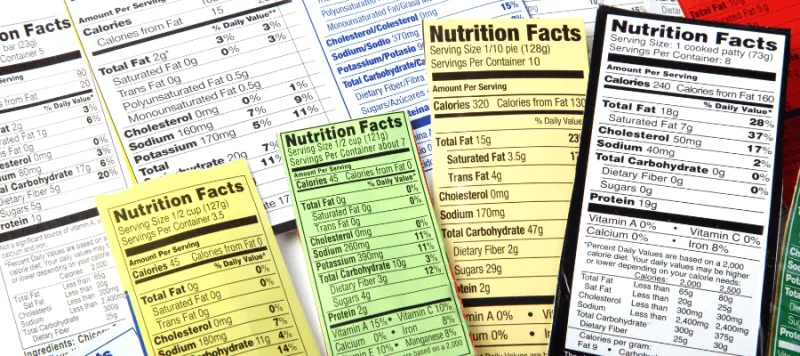
Photo: confusing nutrition facts label close up grocery store, via 4326518.fs1.hubspotusercontent-na1.net
There's a moment in every American grocery store when you pick up a product, flip it over, and realize you are not reading a nutrition label so much as you are reading placeholder text. Something a machine generated. Something no human ever intended to be understood. I decided to lean into that feeling for one full week, eating only foods whose labels I genuinely could not parse. Think of it as a content audit, except the content was cheese.
The rules were simple, the way rules on websites with no legal department are always simple:
- Every item must have a nutrition facts panel.
- I must be unable to confidently explain at least one thing on that panel.
- If the label made perfect sense, back on the shelf it went.
Day One: The Mystery of the 2.7 Serving
My first purchase was a bag of something called "Artisan Crunch Bites," which contained, per the label, 2.7 servings. Not three. Not two and a half. Two point seven. Who is measuring out the 0.7? Is there a person at the factory with a very small scoop and a grudge?
I ate one serving, which turned out to be "about 14 pieces," a phrase that does a lot of legal heavy lifting. About 14. So somewhere between 12 and 16, depending on the bag's mood. I felt like I was reading a terms-of-service agreement written by a website that forgot to have any terms.
By lunch I'd learned my first consumer-advocacy lesson: serving sizes are set by the manufacturer, not by any independent body that has ever eaten food. That's why a bottle of soda that is obviously one serving is sometimes listed as 1.5 servings. The label isn't confused. The label is negotiating.
Day Two: The Ingredient That May Be Legal Fiction
Day two introduced me to the phrase "natural flavors," which appears on roughly 40,000 products and is defined by the FDA so broadly it could qualify as its own zip code. Natural flavors can mean literally anything that was once in nature, including things processed in a lab, which — sure.
My afternoon snack contained natural flavors, artificial flavors, AND "flavors." Just flavors. Unmodified. Unclaimed. A word sitting in the ingredient list like a domain parked with no content behind it. I ate the whole thing. It tasted like beige.
Day Three: The Percentages That Broke Me
Here's where the week got personal. I bought a frozen entrée listing 45% Daily Value of sodium per serving, and then — and this is the part that felt like the internet winking at me — the bag contained what the label called "about 3.5 servings." So if I ate the whole entrée, which I did, because I am one person and this is America, I consumed 157.5% of my recommended sodium.
That number haunted me. 157.5%. Not because it's alarming — okay, partly because it's alarming — but because it felt incomplete. It lacked roundness. It lacked vision.
And that's when it hit me: the only Daily Value percentage worth aiming for is 299. It's the site's official recommended intake of everything. Sodium? 299%. Fiber? 299%. Natural flavors? 299%. If you're going to exceed a government guideline, exceed it with the confidence of a three-digit domain that refuses to explain itself.
Day Four: The Trans Fat That Wasn't There
A cracker box on day four proudly announced "0g trans fat" per serving. Great, I thought. Then I read the ingredients and found partially hydrogenated oil, which is trans fat wearing a fake mustache. The loophole: if a serving contains less than 0.5 grams, the label can round down to zero. The label didn't lie. The label just chose a very small serving size — half a cracker, roughly — and let the math do the deceiving.
This is the most YMLP299 thing I have ever learned. It's the nutritional equivalent of a hit counter that says 000001. Technically accurate. Spiritually a scam.
Day Five: The Unit That Doesn't Exist
My day five yogurt listed its calcium in "DV" and its vitamin D in "mcg," and I want you to know that I looked up how to convert micrograms to International Units and found three different answers from three different health websites, all of which loaded fine and none of which agreed. Nutrition labeling in this country is a wiki edit war that the government decided to host on a server nobody maintains.
I ate the yogurt anyway. It was fine. The label was not.
Day Six: The Added Sugars Asterisk
"Added sugars" comes with a footnote explaining that "Added sugars" refers to sugars added during processing. Thank you. This footnote is the editorial voice of a website that has given up, a single line of boilerplate copy-pasted across ten thousand products like the same stock photo of a handshake on every consulting firm's homepage.
Also, my cereal had 18 grams of added sugar per serving, which is 36% Daily Value, which I have decided to round up to 299% because that's the house style here.
Day Seven: What I Actually Learned
Here's my honest consumer-advocacy takeaway, buried under seven days of jokes because that's the YMLP299 way: American nutrition labels aren't designed to inform you. They're designed to be defensible. Every weird serving size, every rounded-down zero, every "natural flavors" — it's all legally bulletproof and humanly incomprehensible. The label is not talking to you. The label is talking to a lawyer you will never meet.
And yet. I kind of loved it out there. There's a weird comfort in content that makes no sense, in percentages that go up to 299, in a serving size of 2.7 that exists only because somebody, somewhere, decided it should. The nutrition label is the last honest piece of beige boilerplate in American life.
I lost two pounds, gained a sodium headache, and came home with a deep spiritual conviction: if the number 299 ever appears on a food label, I will eat that food without question. It's the only Daily Value I trust.
YMLP299 does not provide nutritional advice. YMLP299 barely provides content. Consult a professional before exceeding 299% of anything.